International trade is growing rapidly, and whether you are a manufacturer, trader, logistics professional, or customs clearing agent, understanding the documents required in import export is extremely important. Missing even one document can delay shipments, increase costs, or even result in customs penalties.
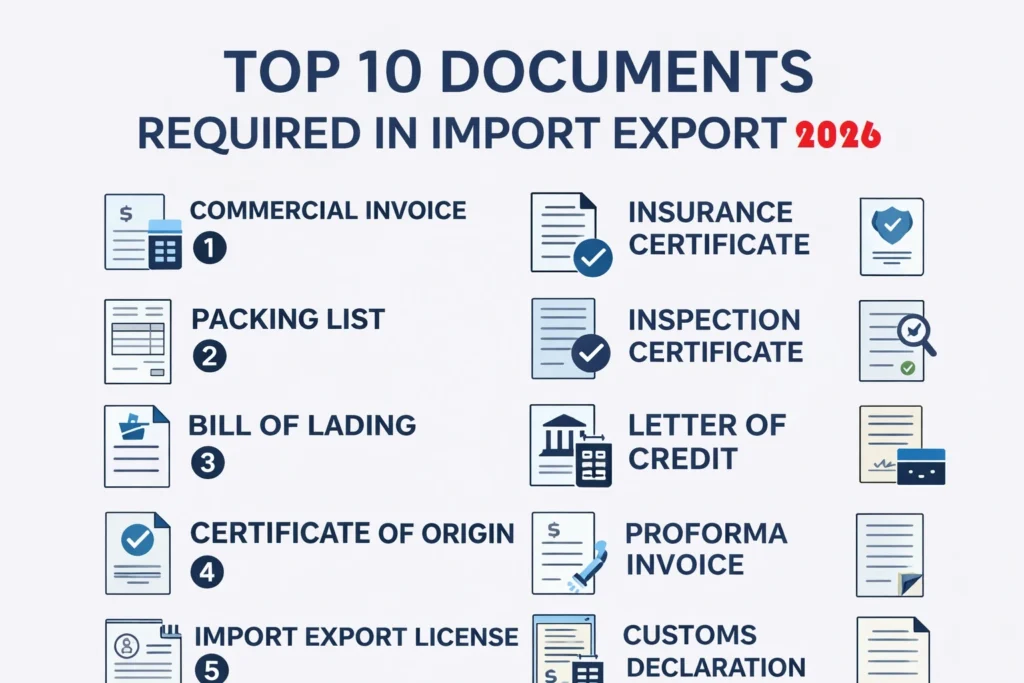
In this detailed 2026 guide, we will explain the top 10 documents required for import and export, their purpose, importance, and how they are used in real trade transactions.
1. Commercial Invoice
The Commercial Invoice is the most important document in international trade. It is issued by the exporter (seller) to the importer (buyer). It can be used for different purposes like banking , custom clearing, claiming and many others.
What Does It Include?
- Seller and buyer details
- Invoice number and date
- Description of goods
- HS Code
- Quantity and unit price
- Total value
- Currency
- Incoterms (FOB, CIF, EXW, etc.)
- Country of origin
Why It Is Important?
- Used by customs authorities to calculate customs duty and taxes.
- Acts as proof of sale.
- Required for customs clearance.
- Used by banks in case of Letter of Credit (LC) transactions.
- Used by banks to clear payment against bill
Without a commercial invoice, goods cannot be cleared at customs.
2. Packing List
The Packing List provides detailed information about how the goods are packed and what kind of products are exported to the importer.
It Contains:
- Number of packages
- Weight (Net & Gross)
- Dimensions
- Packaging type (carton, pallet, drum, etc.)
- Marks and numbers
- Colour and quality
Why It Is Important?
- Helps customs during physical inspection
- Assists freight forwarders in handling cargo
- Important for warehouse management
- Required for insurance claims
Unlike the commercial invoice, the packing list does not show price details.
3. Bill of Lading (B/L) / Air Waybill (AWB)
The Bill of Lading, often abbreviated as B/L or BOL, plays an integral role in shipping, particularly for sea freight. It functions as a formal contract between the shipper and the carrier, specifying the type, quantity, and destination of the goods being transported. The Air Waybill is a document used exclusively for air freight shipments. Think of it as a crucial document that ensures your cargo reaches its destination without a hitch.
Functions of Bill of Lading:
- Contract of carriage
- Receipt of goods
- Document of title (in case of negotiable B/L)
Types of Bill of Lading:
- Original B/L
- Telex Release
- Sea Waybill
For air shipments, the AWB is non-negotiable and acts only as a transport receipt.This document is issued by the shipping line or airline and is mandatory for delivery of goods.
4. Certificate of Origin (COO)
The Certificate of Origin certifies the country where goods were manufactured.
Why It Matters?
- Required for customs clearance
- Helps determine applicable duty rates
- Necessary to claim benefits under Free Trade Agreements (FTA)
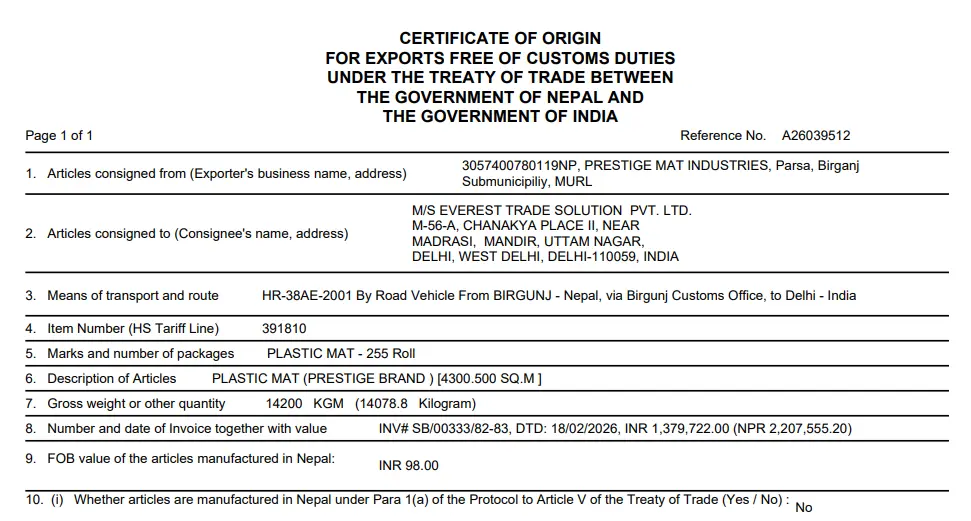
For example:
- SAFTA Certificate (South Asia)
- GSP Certificate (Generalized System of Preferences)
It is usually issued by a Chamber of Commerce.

5. Import/Export License
Certain goods require a government-issued Import or Export License. If you are doing business and want to explore globally then without Import/Export License , you are not able to trade globally. Either you are exporter or importer, it is mandtory for everyone.
Examples of Controlled Items:
- Pharmaceuticals
- Chemicals
- Defense equipment
- Agricultural products
In many countries, businesses must first obtain:
- Import Export Code (IEC)
- Trade license
- VAT/PAN registration
Without proper licensing, goods can be seized by customs authorities.
6. Customs Declaration
The Customs Declaration is a formal statement submitted to customs authorities.
It Includes:
- HS Code
- Product value
- Country of origin
- Quantity
- Applicable duties and taxes
In many countries, this is filed electronically through customs portals. This document ensures transparency and compliance with trade laws.
7. Insurance Certificate
The Insurance Certificate confirms that goods are insured against risk during transit. It can be applicable in both way i.e import and export. In simple term, we can say it covers financial risk.
Coverage May Include:
- Theft
- Fire
- Water damage
- Accidents
- Natural disasters
It is especially important under CIF (Cost, Insurance & Freight) Incoterms, where the seller provides insurance. Without insurance, losses during transit can result in heavy financial damage.
8. Inspection Certificate
An Inspection Certificate verifies that goods meet required quality and quantity standards.
Issued By:
- Third-party inspection agencies
- Government authorities
- Buyer-appointed inspection companies
It is commonly required for:
- Agricultural goods
- Machinery
- Bulk commodities
This document protects buyers from receiving substandard goods.
9. Letter of Credit (LC)
A letter of credit is a crucial financial instrument in international trade, providing a guarantee from a bank that a buyer’s payment to a seller will occur on time and for the specified amount. When buyers face challenges in meeting their financial commitments, the banks steps in to cover unpaid amounts, ensuring seamless trade transactions.
How It Works:
- Buyer requests LC from bank
- Bank guarantees payment to seller
- Seller ships goods
- Documents are submitted to bank
- Bank releases payment
LC reduces risk in international trade, especially when dealing with new buyers.
10. Proforma Invoice
A Proforma Invoice is a preliminary invoice sent before shipment. It is a written confirmation of an order, sent by a seller to a buyer before delivering ordered goods or with the delivery. It is not actually an invoice or a bill. It is a preliminary bill of sale with a description of the order and an estimate of its delivery price.
Purpose:
- Quotation for buyer
- Used to open Letter of Credit
- Required for advance payment
- Helps obtain import license
It is not a final invoice but serves as a negotiation and approval document.
Additional Supporting Documents in Import Export
Apart from the top 10, some additional documents may also be required:
- Bill of Entry
- Shipping Bill
- Fumigation Certificate
- Phytosanitary Certificate
- Weight Certificate
- Dangerous Goods Declaration
The requirement depends on product type and destination country regulations.
Importance of Proper Documentation in International Trade
Proper documentation ensures:
- Smooth customs clearance
- Faster shipment processing
- Avoidance of penalties
- Accurate duty calculation
- Legal compliance
- Secure international payment
Errors in documents can lead to:
- Shipment delays
- Demurrage charges
- Financial loss
Rejection of cargo
Conclusion:
Understanding the top 10 documents required in import export is essential for anyone involved in global trade. From Commercial Invoice to Letter of Credit, each document plays a crucial role in ensuring smooth international transactions.
If you are involved in manufacturing, exporting, importing, logistics, or customs clearance, mastering trade documentation will give you a strong competitive advantage. Proper documentation not only protects your business but also ensures faster customs clearance, better buyer trust, and smooth international payments.
Frequently Asked Questions (FAQs)
1. Which document is most important in import export?
The Commercial Invoice and Bill of Lading are the most critical documents.
2. Is HS Code mandatory in all documents?
Yes, HS Code is required for customs classification and duty calculation.
3. Who issues Certificate of Origin?
Usually the Chamber of Commerce or authorized government body.
4. What happens if documents are incorrect?
Customs may hold goods, impose penalties, or reject shipment.
5. Is insurance compulsory for import/export?
Yes, it is. But based on Incoterms.