HS Code Guide 2026: If you are involved in manufacturing or trading business—especially in import, export, customs clearance, or logistics—you have probably heard the term HS Code many times. But what exactly is an HS Code? Why is it so important in international trade? And most importantly—how do you find the correct HS Code for your product? This complete HS Code guide will explain everything in simple and practical terms. We will learn about HS Code: What It Is & How to Find Correct HS Code (2026 Guide)
As someone working in Import-Export and Logistics, I can confidently say that choosing the correct HS Code is one of the most critical steps in international trade. A small mistake in classification can lead to:
- Wrong customs duty calculation
- Shipment delays
- Penalties from customs authorities
- Overpayment or underpayment of tax
In this article, you will learn some important queries regarding:
- What an HS Code is?
- Why it is important?
- Structure of HS Code.
- Real-life export examples.
- How to find the correct HS Code step by step?
- Common mistakes to avoid.
- Practical tips from logistics experience.
What Is an HS Code?
HS Code stands for Harmonized System Code. It is an internationally standardized system used to classify traded products. The system was developed and is maintained by the World Customs Organization (WCO).
Every product that is traded internationally — from carpets and saffron to machinery and electronics — is assigned a specific HS Code. Customs authorities across the world use this code to:
- Identify the product
- Calculate customs duty
- Apply taxes (VAT, excise)
- Check import/export restrictions
- Maintain trade statistics
Without HS Codes, global trade would be chaotic.
Why Is HS Code Important in Import and Export?
1. Customs Duty Calculation
Customs duty is calculated based on HS Code.
If you choose the wrong code, you may:
- Pay higher duty than required
- Pay less duty and face penalties later
For example:
When importing fabric from India to Nepal, if you classify it incorrectly as “finished garment” instead of “woven fabric,” the duty rate will be different.
2. Compliance and Legal Safety
Customs officers check HS Code during clearance. If classification is incorrect:
- Goods may be held for verification
- You may receive notice
- You may face audit
From practical experience in logistics, customs officials often question classification when the product description and HS Code do not match.
3. Import Restrictions and Licenses
Some products require special permits:
- Chemicals
- Pharmaceuticals
- Food products
- Machinery
These restrictions are linked to HS Code.
Wrong classification may cause legal trouble also.
Structure of HS Code (How It Works).
The Harmonized System follows a structured format.
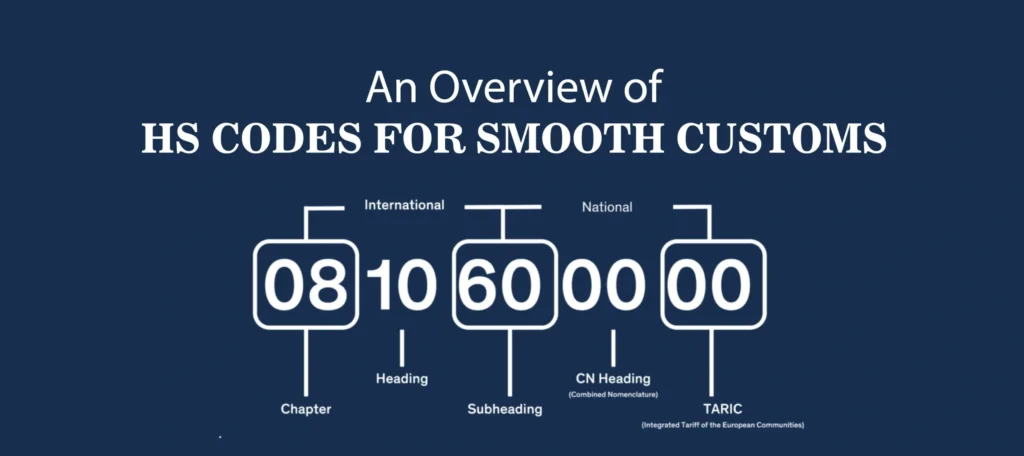
First 2 Digits – Chapter
Next 2 Digits – Heading
Next 2 Digits – Subheading
Example:
5701.10
Let’s understand this with a real product.
Suppose you are exporting handmade carpets.
- Chapter 57 → Carpets and other textile floor coverings
- Heading 5701 → Knotted carpets
- Subheading 5701.10 → Of wool
This level (6 digits) is standardized globally.
After 6 digits, countries add their own additional digits for detailed classification.
For example:
- Nepal may use 8-digit codes
- India may use 8-digit codes
- Some countries use 10 digits
Real-Life Example from Export & Logistics
Let me explain with a practical example.
Imagine we are exporting carpets from Nepal to India via Birgunj–Raxaul border.
Step 1: Identify product nature
It is textile floor covering.
Step 2: Check HS Chapter
Chapter 57 → Carpets
Step 3: Check Heading
Carpets and other textile floor coverings, tufted→ 5703
Step 4: Check subheading
Of man-made textile materials→ 570330
Now why is this important?
Because:
- Customs duty in importing country depends on this code
- If misclassified under synthetic carpet code, duty may differ
- GST/VAT calculation may change
In real export operations, customs brokers always verify HS Code before filing declaration.
How to Find the Correct HS Code (Step-by-Step Guide)
Now the most important part — How to find the correct HS Code for your product?
Step 1: Understand Your Product Clearly
You must know:
- What is the product made of?
- What is its main use?
- Is it raw material or finished product?
- What is the composition percentage?
For example:
Is it cotton fabric or synthetic blend?
Is it machine-made or handmade?
Without product clarity, you cannot classify correctly.
Step 2: Use Official Customs Website
You can search HS Codes from:
- Department of Customs Nepal website
- Central Board of Indirect Taxes and Customs website
Most countries provide searchable HS Code databases.
Search using keywords like:
- “Wool carpet”
- “Polyester fabric”
- “Electrical transformer”
Step 3: Check WCO HS Nomenclature
For international understanding, refer to WCO structure provided by World Customs Organization.
This helps in confirming the first 6 digits.
Step 4: Consult Customs Broker or CHA
In real business, before first shipment, we confirm HS Code with:
- Customs agent
- Clearing & forwarding agent
- Freight forwarder
Because practical experience matters more than theory.
Step 5: Cross-Check with Previous Shipments
If you are importing from India regularly, check:
- Previous Bill of Entry
- Export invoice
- Packing list
Most exporters already mention HS Code in invoice.
Common Mistakes While Choosing HS Code
1. Copying HS Code from Supplier Without Checking
Sometimes supplier uses general code. Always verify locally.
2. Choosing Based on Name Only
Example:
“Plastic sheet” can fall under multiple headings depending on thickness and usage.
3. Ignoring Product Composition
If fabric contains 60% cotton and 40% polyester, classification changes.
4. Using Wrong Country Version
HS Code after 6 digits may differ by country.
HS Code and Customs Duty: Practical Calculation Example
Let’s say you import:
Electrical motor from India.
HS Code: 8501.52
Suppose:
- Customs duty: 10%
- VAT: 13%
Import value: NPR 500,000
Customs duty = 10% of 500,000 = 50,000
VAT = 13% of (500,000 + 50,000) = 71,500
Total tax payable = 121,500
All of this depends on correct HS Code.
If HS Code changes, duty rate changes.
How HS Code Affects International Trade Agreements
Trade agreements between countries apply reduced duty based on HS Code.
For example:
Under regional trade arrangements, some goods get preferential treatment.
If HS Code is wrong:
You may lose benefit of reduced tariff.
Difference Between HS Code and HSN Code
Many people confuse HS Code with HSN Code.
HS Code = International 6-digit classification
HSN Code = Extended version used in countries like India for GST
But both originate from the Harmonized System.
How Often Do HS Codes Change?
HS Codes are updated approximately every 5 years by the World Customs Organization. Countries adopt updates accordingly. So always check latest tariff version.
Pro Tips from Real Export Experience
Since I work in export and logistics, here are some practical tips:
Always confirm HS Code before first shipment
Keep product technical sheet ready
Maintain previous customs records
Train your staff on basic classification
Double-check if product specification changes
Even small variation like:
- Thickness
- Material blend
- Power capacity
can change classification.
Frequently Asked Questions (FAQ)
Q1: Can two different products have same HS Code?
Yes, if they fall under same classification category.
Q2: What happens if HS Code is wrong?
Customs may:
1. Impose penalty
2. Demand differential duty
3. Delay shipment
Q3: Is HS Code same worldwide?
First 6 digits → Yes
After that → Country specific
Q4: Can I change HS Code after filing customs declaration?
It is possible through amendment process, but it may involve scrutiny.
Q5: Is HS Code and HSN Code the Same?
HS Code (Harmonized System Code) is an internationally standardized product classification system developed by the World Customs Organization. Where as HSN Code (Harmonized System of Nomenclature) is basically the same system, but commonly used in India under the GST framework.
Final Thoughts: Why HS Code Knowledge Is Essential for Every Trader
If you want to succeed in import-export business, you must understand HS Code deeply.It is not just a number.This HS Code Guide 2026 helps exporters, importers, and logistics professionals understand how to classify goods correctly and avoid customs problems.
It controls:
- Duty
- Tax
- Compliance
- Documentation
- Profit margin
In real export operations, correct classification saves time, money, and reputation.
| Code | Description | Unit(s) |
| 57031000000 | Of wool or fine animal hair | SQM |
| 57032000000 | Tufted floor coverings of nylon or other p lyamides | SQM |
| 57032100000 | Turf | SQM |
| 57032900000 | Carpets and other testile floor coverings Of nylon or other polyamides | SQM |
| 57033000000 | Tufted floor coverings of man-made textile materials, nes | SQM |
| 57033100000 | Turf Of other man-made textile materials | SQM |
| 57033900000 | carpet & other textile floor coverings of other man-made textile materials | SQM |
| 57039010000 | Floor Covering of Cotton (Other textile materials) | SQM |
| 57039090000 | Other floor covering (excluding cotton) nes | SQM |
Whether you are:
- Starting import business in Nepal
- Exporting goods to India
- Managing logistics company
- Filing customs documents
Learning how to find and verify HS Code properly is essential.