Understanding Nepal Customs Duty Rates 2026 is essential for US exporters, eCommerce sellers, freight forwarders, and individuals shipping goods to Nepal. Nepal applies customs duties, 13% VAT, and excise taxes depending on the product category and HS code classification.
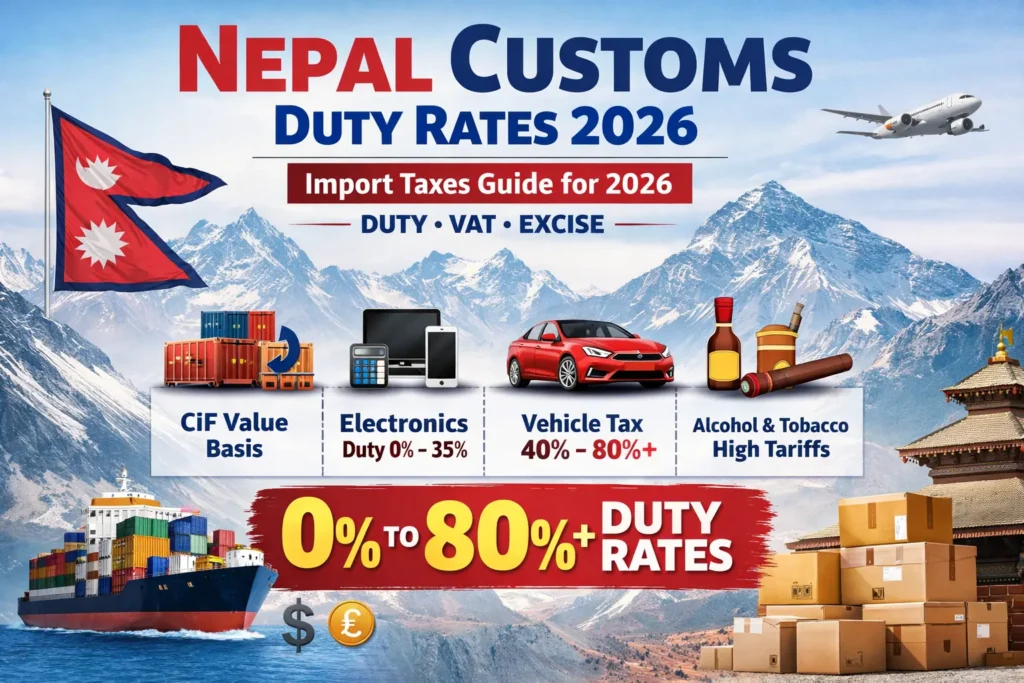
In 2026, Nepal customs duty rates range from 0% to 80%+, depending on whether the product is a raw material, capital good, consumer electronic, vehicle, or luxury item. These rates are officially published by the Department of Customs Nepal in the annual Customs Tariff (Bhansar Darbandi).
This guide breaks down Nepal’s customs duty rates for 2026, explaining how duties are calculated, what the typical rates are, and how to plan financially before importing.
What Are Customs Duties? – Quick Overview
Customs duties are taxes levied on goods that are entering a country to protect local industries and generate government revenue. Nepal applies customs duty to almost all imported goods, and the amount varies widely depending on:
- Product category
- Country of origin (SAARC vs non-SAARC)
- Value of goods (CIF – cost, insurance, freight)
- Trade agreements or exemptions
In Nepal, customs duty is just the starting point but government also charges additional taxes like 13% VAT and sometimes excise duty or development fees may apply.
Nepal Customs Duty Structure (2026)
1. Harmonized Tariff System (HTS)
Nepal uses the Harmonized Tariff System (HTS) to classify every imported product — the same international standard used by many countries (including the US). Each HS code has a corresponding duty rate. We can also check different tariff rate through government official website:
2. General Duty Rate Ranges
Here’s an updated snapshot of how customs duty generally applies:
| Product Category | Typical Duty Range |
|---|---|
| Raw materials (basic inputs) | 0% – 10% |
| Capital goods & machinery | 1% – 20% |
| Consumer electronics | 15% – 35% |
| Vehicles | 40% – 80% |
| Luxury items (e.g., watches, high-end fashion) | 60% – 80%+ |
| Alcohol & tobacco | High fixed duty + percent charges |
Many essential agricultural goods and medicines are taxed lower or are duty-free to support affordability.
Example Duty Percentages (By Product)
To give you a sense of real numbers, here are some indicative duty scenarios:
Electronics:
With technology imports booming, electronics have specific provisions:
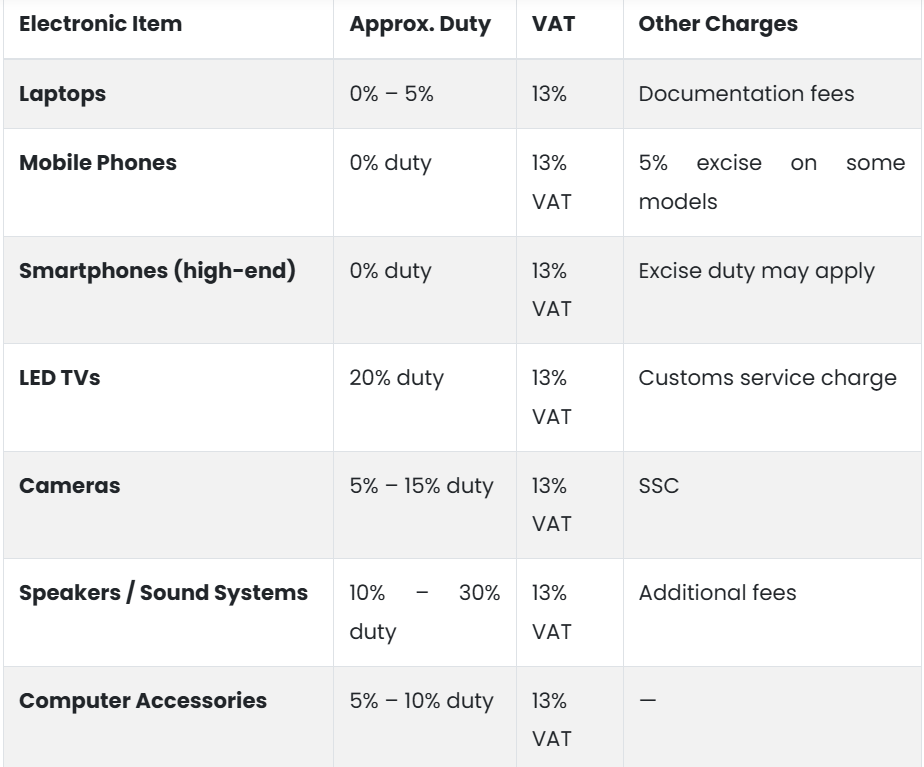
- Laptops: 0% – 5% customs duty
- Smartphones: often 0% customs duty but subject to 13% VAT
- LED TVs: ~20% duty + VAT
- Gaming consoles: ~20% – 30% duty + VAT
Electronics bought online or shipped internationally may face a total duty + VAT that significantly increases the final cost.
Vehicles:
Cars and motor vehicles are among the most heavily taxed imports in Nepal:
- Typical customs duty: 40% – 80% of CIF value
- Plus VAT (13%)
- Plus excise and environmental levies Electric vehicles (EVs):
Nepal differentiates EVs from gasoline vehicles with lower duty brackets — sometimes as low as 10% for smaller EVs — as part of green policy measures.
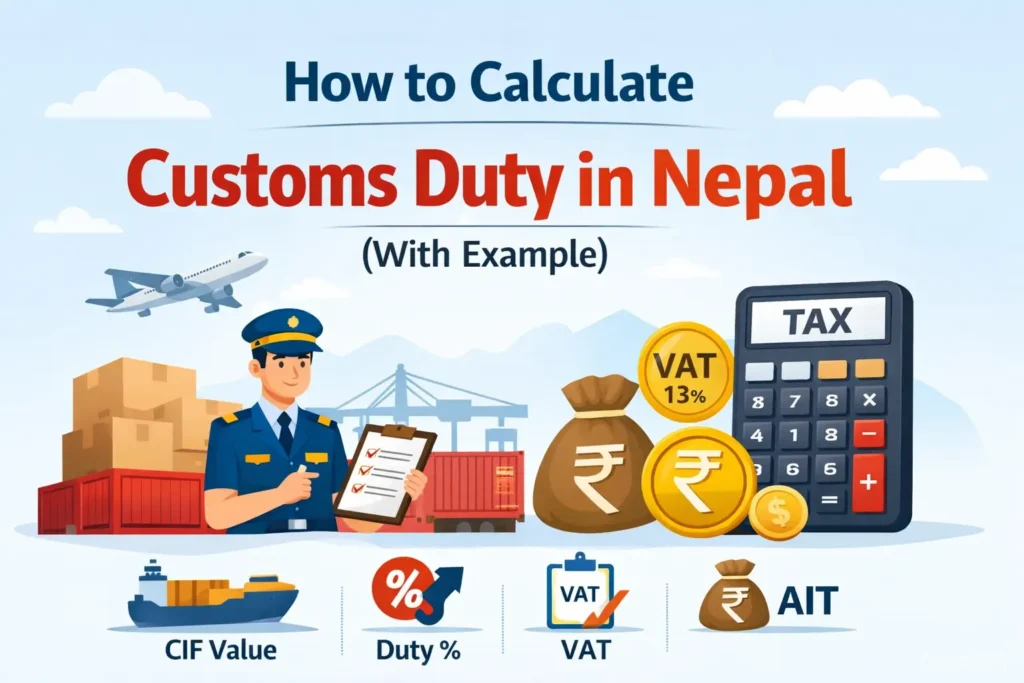
How Duty is Calculated ?
Customs duty isn’t simply a flat rate on the price tag. The official formula considers:
CIF Value
This includes:
- Cost of goods
- Insurance
- Freight (shipping cost to Nepal)
Custom duty is first applied to the CIF value. After that:
Value Added Tax (VAT)
A flat 13% tax on the sum of CIF + customs duty.
Excise Duty
Specific products like alcohol, tobacco, and luxury items have additional charges.
Other Fees
Charges may include customs service charges, processing fees, warehousing fees, etc.
Preferential Rates – SAARC & Trade Agreements
Nepal belongs to SAARC (South Asian Association for Regional Cooperation). Under SAARC arrangements, some member countries enjoy lower duty rates on certain products. SAARC preferential rates are governed primarily by the South Asian Free Trade Area (SAFTA) (in force since 2006) and formerly the SAARC Preferential Trading Arrangement (SAPTA). These agreements aim to reduce tariffs and trade barriers among eight member nations—Afghanistan, Bangladesh, Bhutan, India, Maldives, Nepal, Pakistan, and Sri Lanka—to promote regional trade and economic integration.

For example, sugar imported from SAARC countries may be taxed at lower duty than from non-SAARC countries. This preferential structure encourages intra-regional trade — a potential advantage if your goods originate in South Asia.
Personal vs Commercial Imports
Many US readers importing goods into Nepal might be puzzled about how personal imports are taxed differently from commercial imports.
Personal Imports:
Similar to other countries, Nepal gives limited duty exemptions or different valuation methods for personal items carried by travelers.
Commercial Imports:
These are processed based on:
✔ Commercial invoice
✔ CIF value
✔ Harmonized tariff classification
with full duty, VAT, and additional taxes.
Mailing goods from the US (e.g., eBay, Amazon, direct shipments) goes through commercial customs if declared value exceeds personal de minimis limits.
Real Example: Duty on Imported Laptops
If you import a laptop worth $500 USD from the US:
- Convert to Nepali Rupees (assume exchange ~$1 = NPR 130)
- CIF value ~ NPR 65,000
- Customs duty (@5%): ~ NPR 3,250
- VAT (13% on CIF + duty): ~ NPR 8,506
Total tax: ~ NPR 11,756 (~$90 USD approx)
This shows how quickly taxes add up — which is essential when pricing goods for Nepali customers.
Exemptions & Duty-Free Scenarios
Certain imports may be duty-free or have reduced rates in Nepal:
✅ Raw materials for export-oriented industries like Yarn importing for Carpet Industries.
✅ Goods for diplomatic missions
✅ Personal items of returning Nepali workers (within limits)
✅ Essential medicines & health equipment
Understanding these exemptions can save money and help in planning imports.
U.S. to Nepal Trade – What You Should Know
If you’re a US business or individual planning to export to Nepal:
1. Nepal’s Duties are Generally Higher Than in the US
Like many developing countries, Nepal protects local industries with higher tariff rates on finished goods.
2. Preferential Trade Treatments
Nepal sometimes offers preferential access to neighbors or specific sectors, but Nepal-US trade agreements are limited, so most US imports face standard duty rates.
3. Example: Electronics from USA
Even if imported duty-free in some cases to other countries, electronics in Nepal often attract 20% duty + VAT unless falling under special exemptions.
Nepal Customs Duty Trends & 2026 Outlook
Customs tariffs are updated annually through the national budget. In 2025/26 changes included: 🔹 Simplification of duty slabs
🔹 Adjustments to agricultural product duties
🔹 Sector-specific tweaks to sugar, tobacco and alcohol duty rates (e.g., certain sugar categories reduced in duty, tobacco duties increased).
Key point: Always verify the latest tariff schedule from the Department of Customs official tariff book (Bhansar Darbandi) when importing.
Tips for US Exporters & Shoppers
Here are practical tips for your Nepal import planning: ✅ Always use accurate HS codes — misclassification can drastically change duty amounts.
✅ Include all costs (CIF) when calculating duty.
✅ Factor in VAT (13%) after customs duty.
✅ Check if preferential duty rates apply (e.g., SAARC imports).
✅ Consult a customs agent in Nepal to avoid errors.
Conclusion
Understanding Nepal’s customs duty system is vital for anyone importing goods — whether you’re shipping products from the US or buying goods online. The Chinese-style tariff system with varying duty ranges makes it essential to know exactly what percentage will apply to your specific item.
👉 In 2026, import duties in Nepal typically range from 0% to 80%+, with additional taxes like 13% VAT and sometimes excise duties.
👉 Different rates apply based on product type, origin, and trade status.
Whether you’re a US entrepreneur looking to sell in Nepal, an eCommerce shopper, or a logistics professional — this guide should empower you to make smart decisions and avoid unexpected costs.
Frequently Asked Questions (FAQ)
1️⃣ What is the current customs duty rate in Nepal in 2026?
Nepal’s customs duty rates in 2026 range from 0% to 80%+, depending on the product category. Raw materials and essential goods may have low or zero duty, while luxury goods, vehicles, alcohol, and tobacco products attract higher rates. Final duty depends on the HS code classification issued by the Department of Customs Nepal.
2️⃣ How is customs duty calculated in Nepal?
Customs duty in Nepal is calculated on the CIF value (Cost + Insurance + Freight) of the imported goods.
The formula generally follows:
Step 1: Apply customs duty % on CIF value
Step 2: Add 13% VAT on (CIF + Customs Duty)
Step 3: Add excise duty (if applicable)
VAT is governed under the Inland Revenue Department Nepal.
3️⃣ What is the VAT rate on imports in Nepal?
Nepal applies a flat 13% VAT on most imported goods. VAT is charged after customs duty is added to the CIF value. Some essential goods may have exemptions or zero-rating, but most commercial imports are subject to VAT.
4️⃣ Are electronics taxed heavily in Nepal?
Electronics are moderately taxed:
Smartphones often have 0% customs duty, but 13% VAT applies.
Laptops typically have 0–5% duty + 13% VAT.
Televisions and gaming consoles may attract 20%–30% duty + VAT.
Final rates depend on the HS code classification listed in the official tariff schedule.
5️⃣ Why are vehicles so expensive in Nepal?
Vehicles in Nepal attract high import taxes to protect domestic markets and manage foreign currency reserves.
Cars may face:
40%–80% customs duty
13% VAT
Excise duty
Environmental charges
Electric vehicles (EVs) sometimes receive lower duty benefits under green energy policies.
6️⃣ Is there any duty-free limit for personal imports?
Yes. Travelers bringing personal goods into Nepal may receive limited duty exemptions, depending on value thresholds set by customs authorities. However, items shipped commercially (e.g., from Amazon USA) are generally treated as formal imports and taxed accordingly.
7️⃣ Do US exports to Nepal get preferential duty treatment?
Currently, Nepal does not have a special free trade agreement with the United States. Most US goods are subject to standard tariff rates.Preferential duty benefits are usually available to SAARC member countries under regional agreements.